

|
The Naked Emperor and Science at the Crossroads
March 2019
In 1837, in the picturesque town of Copenhagen, Denmark, a remarkable story by a then little known author, Hans Christian Andersen, was published ostensibly for children. Andersen called his "fantastic tale", "The Emperor's New Clothes". Readers may be familiar with it. Some may appreciate its profundity. Indeed, so felicitous is it to the condition we find ourselves in today that it is referred to not only by those who properly understand its relevance but also, inevitably, by those, who like Pharaoh's magicians of old, are capable only of shallow imitations and distortions of the talking points and demeanour of the men they would pass for.
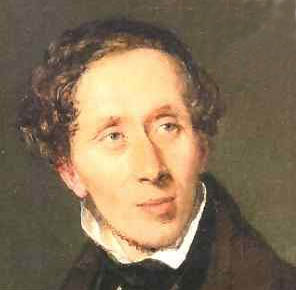 |
| Hans Christian Andersen (1805-1875) |
Briefly the Andersen story is as follows:
An Emperor with a weakness for sartorial indulgence becomes the victim of a pair of confidence tricksters posing as tailors. The wily pair manage to convince the men of the land that the clothes they fashion have a very peculiar and magical quality: only intelligent persons, fit for their jobs, are able to see them! The Emperor soon hears of this and the tailors are summoned to his palace and set to work on suitable garb for the royal personage. As the audacious would be tailors feign to work away at nothing at all on their empty looms, several of the Emperor's top men and ministers are sent to check on the progress. Of course they see nothing on the looms, but not one of them will report the true state of affairs for fear of being thought a fool. The effect is self-perpetuating. The more men that come under the psychological "spell" the harder it is to break, for each man thinks himself the only one incapable of seeing the clothes. Even the Emperor dares not admit the truth about what he actually sees to his men. Instead he rewards the "tailors" with gold and medals and the honorary title of "Lord Weaver". Finally sanity is restored not by the privileged, though compromised men of the Emperor's court, but by an innocent child of the ordinary folk who points out the painfully obvious to a crowd of heretofore blinded and fawning onlookers - much to the embarrassment of the stark naked monarch parading proudly through the town in his brand new "clothes"!
Flash forward a century and a quarter later to 1972. A British professor, Herbert Dingle, also writes a story, one that is published as a book he calls, "Science at the Crossroads". In it he tells the tale not of a foolish and vainglorious Emperor in a far away time and place, but about an unmistakable and fatal fallacy in Albert Einstein's special theory of relativity.
It is, nonetheless, essentially the same tale ....(1)
 |
| Above: a satirical illustration for "The Emperor's New Clothes". Curiously, not only does the "Emperor" have more than a passing resemblance to Albert Einstein, the caption for one of the fawning onlookers reads: "The King's tailor takes us to the fourth dimension ...." The poster on the wall in the top left corner declares: "By decree of the King: those that do not see the beautiful clothes of his majesty will be branded a traitor." |
“Truly I tell you, unless you change and become like little children, you will never enter the kingdom of heaven."
Matthew 1:3
 |
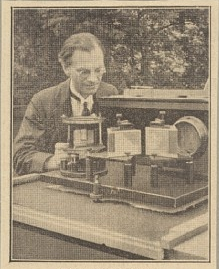 |
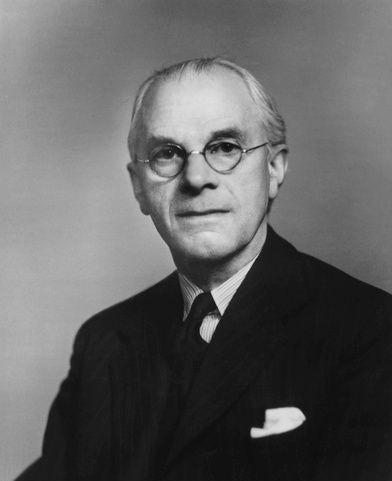
| Professor Herbert Dingle (left) and (right) in his younger days preparing for an eclipse. | |
Professor Herbert Dingle (1890-1978) was no stranger to the British scientific community. He served as President of the Royal Astronomical Society in the early 1950s after having been a Fellow for thirty years, and founded the British Society for the Philosophy of Science and its journal, as well as the British Society for the History of Science, for which he served as President from 1955 to 1957.
Among Dingle's many esteemed capacities he was also a physicist of note, an expert in spectroscopy, especially as applied to the study of astronomy, a fact that rendered him particularly qualified to understand the troubling optical experiments that Albert Einstein cited as an impetus for the formulation of his relativity theory. Dingle also wrote a number of books and articles and, remarkably, was known until his retirement as an eminent proponent, not critic, of the theory of special relativity. Indeed, he was well-acquainted with many of the physicists most famously associated with it, Einstein, Eddington, Tolman, Whittaker, Schrodinger, Born and Bridgman among them. Some he knew intimately.
 |
The beauty of Professor Dingle's fatal criticism of special relativity theory is its simplicity. Much like the innocent child in Andersen's story one need not be an expert to understand it (or a mathematician). Neither does one need more than an elementary understanding of physics. All one really needs is a mind capable of reason. Specifically, one needs a mind capable of knowing the difference between the impossible and the possible - not as a matter of subjective opinion, but as a matter of logical necessity.
It really is no exaggeration to say that the book Dingle wrote, Science at the Crossroads, is one of the most important of the last century not only because of the intellectual question with which it treats, but also because of the far more important moral one it addresses. The latter question arises due to the scandalous treatment Dingle's contribution to the former received at the hands of the scientific community; a treatment that (to not mince words) was not only cowardly and lazy, but in some cases, plain dishonest. Dingle writes:
".... the more serious lapse is the moral one, not only because of the intrinsically greater seriousness of a moral as compared with an intellectual fault, but also because the nature of science itself does not ensure its eventual correction as it does when the mistake is intellectual." (2)
Moreover, Dingle is anxious throughout the book to draw much needed attention to the inherent dangers of such a moral lapse, particularly among scientists. In an included letter to the Press Council he writes:
"The new scientific age has unavoidably made public safety dependent on the incomprehensible and uncontrollable activities of scientists, who have therefore now an additional obligation to preserve the utmost integrity in their work." (3)
and elsewhere,
"The fact must be plainly stated that, in a situation in which the safety of the world lies in the hands of a comparatively minute body of men whose activities are necessarily so abstruse as to be altogether beyond the comprehension of the vast majority, the obligation that rests on them to honour unreservedly the traditional scientific principle of utter subservience to truth and rejection of prejudice is one of which they are quite unaware." (4)
Though Dingle mentions specifically and repeatedly his concerns about experiments and practical applications in which special relativity "corrections" may be blindly applied(5), it is when his warnings are of a more general character, and include his concerns about the role the media plays in suppressing information about the activities of scientists(6), that they are particularly prophetic. One need only reflect upon atrocities such as the psychiatry racket and geoengineering in recent times to appreciate his foresight. And despite the fact that Dingle is, in the present writer's opinion (whether through tact, timidity or innocence) far too kind in his book to the man responsible for the theory he criticises (i.e. Einstein)(7), Science at the Crossroads is nonetheless essential reading for any student of knowledge and seeker of truth who wants to understand the actual condition of scientific thought today, beyond the mindless dogma and pseudo-scientific bias of our compromised and increasingly superfluous educational institutions. The fact that one is not likely these days to find Dingle's book on the curriculum reading lists of same institutions is a sad indictment of the latter, not the former.
The beauty of Professor Dingle's fatal criticism of special relativity theory is its simplicity. Much like the innocent child in Andersen's story one need not be an expert to understand it (or a mathematician). Neither does one need more than an elementary understanding of physics. All one really needs is a mind capable of reason. Specifically, one needs a mind capable of knowing the difference between the impossible and the possible - not as a matter of subjective opinion, but as a matter of logical necessity.
Of course, a certain degree of psychological freedom also helps.
Dingle emphasises time and again in his book the importance of seeing past the "pseudo-profundity" and "metaphysical obscurity"(8) falsely associated with the theory of special relativity. Speaking from years of experience of trying in vain to get other members of the scientific community in Britain to address his criticism properly, Dingle tells of a kind of "word magic" or "evil spell cast by the word 'relativity' - a word that immediately reduces the mental power of even leading physicists to impotence". He writes:
"The magical influence of this word has transformed science in this field into a superstition as powerful as any to be found in primitive tribes." (9)
Elsewhere, in language more palatable perhaps to those accustomed to scientific jargon, Dingle describes a "conditioned reflex" to the word "relativity" itself, that "conjures up a dread image, compelling an instant, unreasoning retreat" by otherwise capable and intelligent men who are nonetheless quite convinced a priori that they are unable to understand something that is in fact really quite simple as far as theories in the physical sciences go. Dingle assures readers:
" [Special Relativity's] reputation as the supreme model of the incomprehensible is wholly spurious." (10)
He means it. Anyone who has done an introductory course in special relativity will tell you that the two postulates that essentially define it are more or less covered in the first lecture, after which countless lectures of comparatively complicated mathematical elaboration follow. Happily for truth seekers, Dingle's criticism is found at the most fundamental level, that of the postulates themselves and their physical implications, making the mathematics irrelevant to the discussion; a fact that circumvents their use as a mystification device.
 |
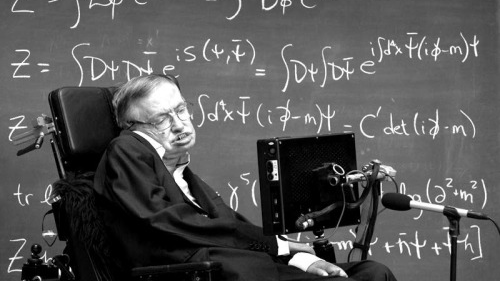 |
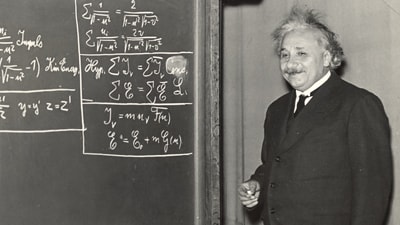
| Edification or mystification? Above: Einstein and Hawking and the obligatory blackboard photo-op. |
It is a device employed even at the most superficial levels. Those who make it their business to control the way the masses think about the world and indeed the universe we live in are, for example, fond of using blackboards filled with impressive looking mathematical equations and symbology as backgrounds for their carefully chosen spokesmen for "science". Indeed, the gimmick is almost ubiquitous in science-related photo ops and interviews. Of course, its purpose is not edification - it is perfectly understood that the majority of viewers are completely ill equipped to decipher the algebra and calculus equations of higher level physics (incomprehensible hieroglyphics to most of us) or to know if the nonsense being spouted by the talking heads placed strategically in front of them has anything necessarily to do with them. Or for that matter, if the equations are necessarily telling the truth in any case, though they be mathematically impeccable in and of themselves.
This latter point is important to understand. In our 2017 article on the defunct Darwinian theory we discuss the importance of knowing the difference between science and mythology, particularly when the latter comes to us in the jargon of the former, rather than in a language in which it is more easily recognizable, such as poetry for instance. As Dingle points out in Science at the Crossroads (citing Italian astronomer, Galileo) mathematics too is a language, particularly the language of Science, and especially physics. There is no mystery about this. Man simply discovered long ago that mathematics was the most convenient way of expressing conclusions derived from physical experimentation and observation for the purposes of prediction - which is of course the essential goal of objective scientific method.
It can do this in two ways. Firstly it can do so mistakenly, because it contains error. This kind of mathematical "lie", however, is less common than one might think in Science, especially in the more widely publicised and influential works. There are a number of reasons for this, not least of which is the scrutiny to which such works are subject by scientists and laymen alike. Another reason is the difficulty of denying them once they are discovered. (Though relativists, like dogmatists in general, show remarkable resilience to change even in the face of such discoveries.) In any case, far more common and effective than people realise, including physicists themselves, are the lies mathematics tells not when it is faulty, but when it is not. It is exactly analogous to grammar in a sentence or a paragraph. The grammar and language may be impeccable, elegant and beautiful even, yet the content may nonetheless be false. And the sophistication and grammatical rectitude of the prose only serves to make the falsity of the content harder to identify in many cases.
|
How Many Apples Does Albert Have?
Dingle gives a number of examples in his book of how mathematics can lead to solutions that are false, or to put it another way, to solutions that have nothing to do with corporeal experience, among them the complex (imaginary) number solutions of a cube root for example, but actually the point can be made even more simply.
"On Sunday I picked six apples from my tree. The next day my friend Jan, who lives a couple of blocks away, came by and I gave her one of my apples, which she ate immediately in front of me. At precisely the same time that she was eating the apple I gave her, she was baking a pie at her house with another three of them, which she stole from me without my permission. (I'm going to have to have word to Jan about that!) On Wednesday I bought another five from the shop, but on the way home a unicorn ate two from my bag while I wasn't looking. (I saw it myself!) Then on Friday my friend Joe, who is a magician by trade, came by and made three disappear into thin air, while the centaur that lives in my wardrobe (with his family) ate the other two, leaving the cores in the pockets of my tuxedo - a disgusting habit about which I have had cause to remonstrate with him on several occasions.
Now we ask: is Albert telling the truth?
It is clear that whatever the answer may be, one thing is certain: the mathematics is irrelevant to the final question, not because it is faulty, but precisely because it isn't. And even if it were faulty we may be able to save ourselves the trouble of checking it anyway if we can prove the falsity of the story in other ways - a quick search of Albert's house and yard for instance, or a chat to Jan and Joe. Or some research into centaurs and unicorns! Yet even these kinds of empirical investigations may be superfluous. For instance, if we can identify elements of the story that are innately impossible it could save us even more trouble in drawing our conclusions. In any case the quality of the mathematics only becomes important once the veracity, or indeed the plausibility and rationality of the story's other details are confirmed. |








|
Sure, we can dream up a universe if we want to. We may even prescribe for it all kinds of wonderfully symmetrical mathematics and scintillating metaphor, or "prove" it by devising a suitably abstruse method of confirming what we implicitly assume in the first place. Heck, if worse comes to worst we can just invent, bend or suitably interpret some experimental results to our liking! Or pretend that our own explanation is the only one possible, and that the pesky, logical absurdities inherent in it are mere "appearances".... until they aren't. Of course, it goes without saying that we will have to suppress any evidence we find inconvenient. But while all of that may be able to tell us something about our subjective psychology it can none of it tell us anything about the true nature of our objective reality.
|
Dingle on Mathematical Ability
|
The problem, explains Dingle, is that for some time now, and especially since the general acceptance by the scientific community (on questionable grounds) of Einstein's theories of relativity in the first decades of last century, mathematics has all too often become the master of both experience and reason in scientific thought.(11) A theory is found acceptable simply because the maths used to describe it is pretty or suggestively convenient, without recourse to experimental confirmation (except spuriously), and even more pertinently for our purposes, without passing the strict requirements of logical viability. Indeed one must, of necessity, consider suspect any claim that a theory that is logically impossible has been experimentally "proven" or practically applied. In fact, mathematical theories are all too often proffered in lieu of, or pending, experimental confirmation or observation, while later it is conveniently forgotten that the necessary confirmation was never really forthcoming. Even worse are the absurdities and affronts to logic and common sense that ensue.
The story of Albert and the apples above provides a helpful analogy to understanding the corruption of modern scientific thought and, in particular, the nature of the flaw inherent in the special theory of relativity. It is clear that Jan cannot be both in Albert's front yard and at home baking a pie at the same time. Neither can Albert both see the unicorn eating his apples and not see it simultaneously. Therefore we do not need to concern ourselves with the existence of unicorns or investigate the other details of the story to know that the tale is at least partially false and therefore untenable.
Sure, we can dream up a universe if we want to, in which some kind of amazing bi-location or omni-vision property is possible. We may even prescribe for it all kinds of wonderfully symmetrical mathematics and scintillating metaphor, or "prove" it by devising a suitably abstruse method of confirming what we implicitly assume in the first place. Heck, if worse comes to worst we can just invent, bend or suitably interpret some experimental results to our liking! Or pretend that our own explanation is the only one possible, and that the pesky, logical absurdities inherent in it are mere "appearances".... until they aren't. Of course, it goes without saying that we will have to suppress any evidence we find inconvenient. But while all of that may be able to tell us something about our subjective psychology it can none of it tell us anything about the true nature of our objective reality.
|
One must, of necessity, consider suspect any claim that a theory that is logically impossible has been experimentally "proven" or practically applied.
What is important to understand is that while even experimentation is open to subjective interpretation and bias, reason and logic are not(13), and it is to the category of logical non-viability that belongs Dingle's fatal criticism of the "story" of special relativity.
The details of the story are encapsulated in two basic postulates. We will try to keep it brief.
The first postulate, often called the principle of relativity, essentially tells us that there is no absolute frame or standard of rest. Don't be put off by the jargon. It is really quite simple. Have you ever been sitting on a train at rest on a platform when another train on the platform opposite begins to move slowly away from the station? For a second or two you are not quite sure who is moving, you or it. Next time that happens, notice what you do to find out - you look to the platform itself. The platform, which is really the Earth, is the "standard of rest" in this case. Now imagine that you and the other train are suspended in "empty" space (if that were possible) and the latter is moving by you at constant speed. Who is to say if it is it that is moving off to the right or you rather that is moving off to the left? The principle of relativity basically says that each way of looking at it is equally valid, and that all standards of rest are mere conveniences.
The second postulate of the theory of special relativity states that light travels at 300,000 km/sec (or c for short) in every inertial reference frame. Einstein adopted this postulate (only to abandon it later for the formulation of his general relativity theory) to explain away the results of some late nineteenth and early twentieth century interferometer experiments that were causing great consternation to the high priests of scientism at the time; especially the one conducted by Michelson and Morley in 1887.(14)
|
Dingle on Prophetic Insight
|
In short, the aim of the Michelson-Morley experiment was to measure the effect of something scientists called the "luminiferous ether", a substance presumed to pervade the whole universe as the invisible, essential matter of space itself, and the medium through which light waves propagated. It was not an unreasonable assumption. Just as ocean waves travel in water and sound waves in air, light, which exhibits wave-like properties, was presumed to need a medium. Einstein, however, did not like the idea of an ether because of the threat it posed to his own cherished idea of a universe without an absolute standard of rest or "preferred reference frame". So for the purposes of what came to be known as the special theory of relativity he simply discarded it - by decree, more or less. (Inexplicably, however, he did not discard the notion of light as a wave.) And though he and others would later cite the results of the 1887 Michelson-Morley experiment as an empirical basis for his decision, the non-existence of the ether (or "ether velocity") was in fact nothing more than a theoretical convenience, and moreover, a convenience seriously at odds with the results of other notable optical experiments of the period, both previous and subsequent, Michelson-Gale and Sagnac among them.(15)
|
It is a general rule that the void left by substance is invariably filled by fancy, and the iconic image of "Einstein the Scientist" or "Einstein the Genius" has clearly been, and continues to be, fostered deliberately in the minds of a public that is, for the most part, too scientifically naive to question it.
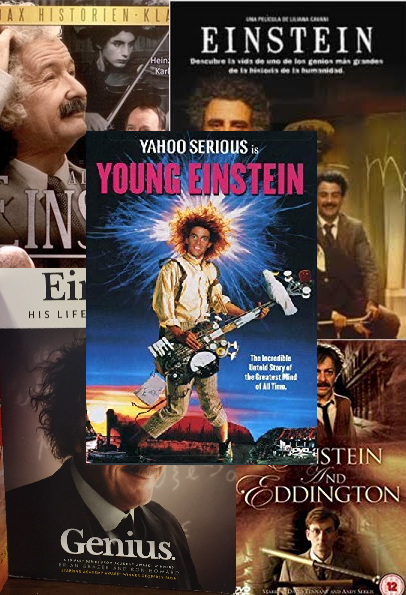 |
| Above: an Einstein for all ages and all times. Continuously updated of course. |
Incidentally, the dependence of Einstein's theories on something more akin to decree than scientific method or principle (notwithstanding specious claims of empirical confirmation by those who either do not understand what they are talking about or who have a vested interest in appearing to)(16) goes a long way to explaining the cult-like status to which Einstein has been elevated since the time of their formulation, mostly by the mainstream media and now also on the internet, both in specialised and non-specialised outlets.
It is a general rule that the void left by substance is invariably filled by fancy, and the iconic image of "Einstein the Scientist" or "Einstein the Genius" has clearly been, and continues to be, fostered deliberately in the minds of a public that is, for the most part, too scientifically naive to question it.(17) The present writer recently met a young man in Europe who was wearing a T-shirt emblazoned with a large photograph of Einstein and a one line caption declaring his "genius". When the youth was asked what he knew about the theories of Einstein he admitted that he knew nothing at all, but had seen an impressive film about him on TV. In fact, though he was too young, naive and brainwashed to understand it, what he had actually seen was a subtle advertisement for (1) the nation calling itself "Israel", (2) the spiritually lifeless religion of Judaeo-atheism, and (3) the pernicious and insidious philosophy of moral relativism that is the chief "gift" of the latter to the world. In any case, the response of the young man is a typical one.
"The equations worked, so the 'experimenters' became convinced that the theory, whatever it was, must be right. The superior minds acknowledged that they did not understand it, but the majority could not rise to that height. Nothing is more powerful in producing the illusion that one understands something that one does not, than constant repetition of the words used to express it, and the lesser minds deceived themselves by supposing that terms like 'dilation of time' had a self-evident meaning, and regarded with contempt those stupid enough to imagine that they required explanation. Anyone who cares to examine the literature from 1920 to the present day, even if he has not had personal experience of the development, can see the gradual growth of dogmatic acceptance of the theory and contempt for its critics, right up to the extreme form exhibited today by those who learnt it from those who learnt it from those who failed to understand it at the beginning." (18)
Elsewhere Dingle laments in terms reminiscent of the plight of the Naked Emperor's advisors:
"....would that the revelation would come to them that the theory appears to them to be nonsense because it is nonsense and not because they are too stupid to understand it!" (19)
When, however, Dingle poses the question (regarding the fatal flaw in special relativity that we will come to presently),
"How is it possible that such an obvious absurdity should not only have ever been believed but should have been maintained and made the basis of almost the whole of modern physics for more than half a century; and that, even when pointed out, its recognition should have been universally and strenuously resisted, in defiance of all reason and all the traditions and principles of science ....?" (20)
he fails to make a clear connection between the falling away from sound scientific principle and rationality on the one hand and the empowerment of the mainstream media by unprecedented technological advances on the other. The two are obviously related. As is the takeover of academia and the inordinate rise of the power of finance and associated monopolies that accompanied them. (In all cases we see the rise of distinctly anti-Christian elements.) It is easy to forget that physicists and scientists are not any more immune to mass psychological manipulation or professional intimidation and temptation than the rest of us.
|
....would that the revelation would come to them that the theory appears to them to be nonsense because it is nonsense and not because they are too stupid to understand it!
Fact is, the cult of Einstein is an indispensable part of the rampant politicisation of scientific thought that has plagued it now for at least a century, particularly in the aftermath of two devastating world wars that radically altered the geopolitical face of the Earth, from the Balfour declaration of the first to the occupation of Europe that followed the second and continues to this day, truth be told. (Though there are signs now of serious cracks in the works.) Speaking of Jewish mathematician, Hermann Minkowski (1864-1909), who provided Einstein with much of the mathematics the latter would use for the formulation of the general theory of relativity, as well as the mathematical bulk of a course on the special version (and a chief characteristic of the mythology of both), Dingle observes:
"The return to mediaeval scholasticism, against which the protest of Bacon and the other pioneers of modern science was thought to have been finally successful, was now complete. With Minkowski's work physics had escaped from experiment and been captured by mathematicians." (21)
and elsewhere,
"It is to Minkowski that we owe the idea of a 'space-time' as an objective reality - which is perhaps the chief agent in the transformation of the whole subject from the ground of intelligible physics into the heaven (or hell) of metaphysics, where it has become, instead of an object for intelligent inquiry, an idol to be blindly worshipped." (22)
And an idol cannot be questioned. Not with impunity anyway. Thus when Einstein declared that light waves move at a constant velocity in empty space with no medium to travel in and regardless of the reference frame, it came to be accepted, if not immediately, then as soon as the necessary "confirmations" could be arranged. (23) If one were to ask what exactly the speed of light is constant relative to, the answer of course would be nothing, and everything, all at once.
|
The Great Ballistic Road Race and the Magic Bullet You and I decide to conduct an experiment ....
First you take a really fast sports car some distance up a remote highway from where I'm standing at the side of the road. With a loud roar you start the engine and begin towards me at full throttle, accelerating up to a constant speed of 300 km/hr. You then take a gun from the passenger seat, roll down your window, and take aim at a target located 300 metres further up the road from me. I also have a gun, which is identical to yours. At the exact moment when our guns are equidistant from the target we both fire. (Our sense of timing is impeccable!) Meanwhile, at the target we have a super high speed slow motion camera set up on a tripod to record the arrival of our bullets, which we have suitably coloured for identification. The question is: which bullet gets there first?
You see, man has been puzzled by the nature of light for a very long time. This is because it is so seemingly capricious. In some ways it behaves exactly like a wave, while in other ways it behaves more like a particle, or indeed, a bullet. In fact this latter way of looking at it is sometimes called the "ballistic" model of light. Eventually scientists just resigned themselves to saying that light has a "dual nature". |







 The implications of Einstein's light postulate are literally surreal. Obviously if we are going to fix c no matter the frame of reference we are going to have to make some extraordinary changes (mathematically) to our natural and intuitive concepts of distance and time in order to compensate.(26) No longer can these be fixed, reliable concepts, but will henceforth need to be as variable as the relative motion of the subjects observing them, at least for velocities comparable to the speed of light. Specifically, we are obliged to accept that time slows down and length contracts for moving clocks and measuring rods. In special relativity this is a mathematical consequence, known as the "Lorentz transformation"(27), of the two aforementioned postulates of the theory; postulates that Einstein used to arbitrarily re-define space and time.(28)
Happily, all one really needs to understand for the purpose of the present discussion is that according to special relativity theory a clock moving in uniform rectilinear motion works slower than a clock that is at rest relative to it. Or to put it as simply as possible, a moving clock works slower than a stationary one. Some of you may already have noticed the paradox(29) inherent in that statement, but in any case let's follow it through to the bitter end.
|
Given then the extraordinary implications for our whole way of looking at the world and the universe (which go far beyond the realm of science truth be told), a sensible person might be forgiven for wondering what the basis is exactly for the theory of special relativity, beyond the mere say so of prophets and "angels" of light like Einstein, and little else.
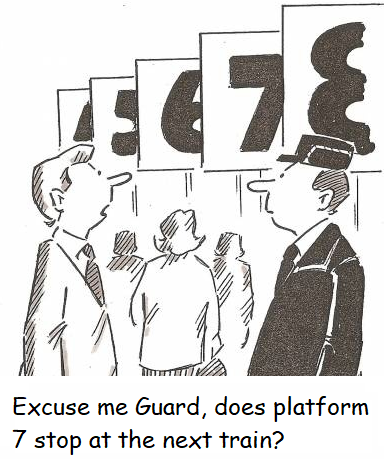 |
Remember: according to the first postulate of the theory there is no absolute standard of rest. But then, who is to say whether it is the train on the platform opposite you that is whizzing past at great speed to the right, or you rather that is whizzing past it at the same speed to the left? The first postulate insists that both points of view are equally valid - you are not allowed to look to the platform or anything else for reference. But in that case which clock is running slower? According to the theory of special relativity we have two equally "valid" predictions (depending on which reference frame we choose to be the one at rest) that are mutually contradictory. If I choose to think of you and your clock at rest, then it is the other clock that is running slower. On the other hand, if I choose to think of the man on the other train at rest, and you moving, then it is your clock that is running slow. Clearly two clocks cannot both be running slower than the other at the same time. That is patently absurd. In fact, it is impossible, and the theory that gives rise to it can be no more than a nonsense tale, fit for amusement or deception perhaps, but completely untenable as science. Indeed, when it was suggested to renowned physicist, Ernest Rutherford, at a dinner in 1910 that no Anglo-Saxon could comprehend special relativity theory, he famously retorted:
“No! they have too much sense!”
But not sense enough, apparently, in the long run. What Dingle did essentially was to simply pose the question: how, according to the theory, can one tell which of the clocks is running slower? The response that he got, or the lack of one, both to the question and the argument it encapsulates, is what makes his story and that of Andersen's daft Emperor so very alike.
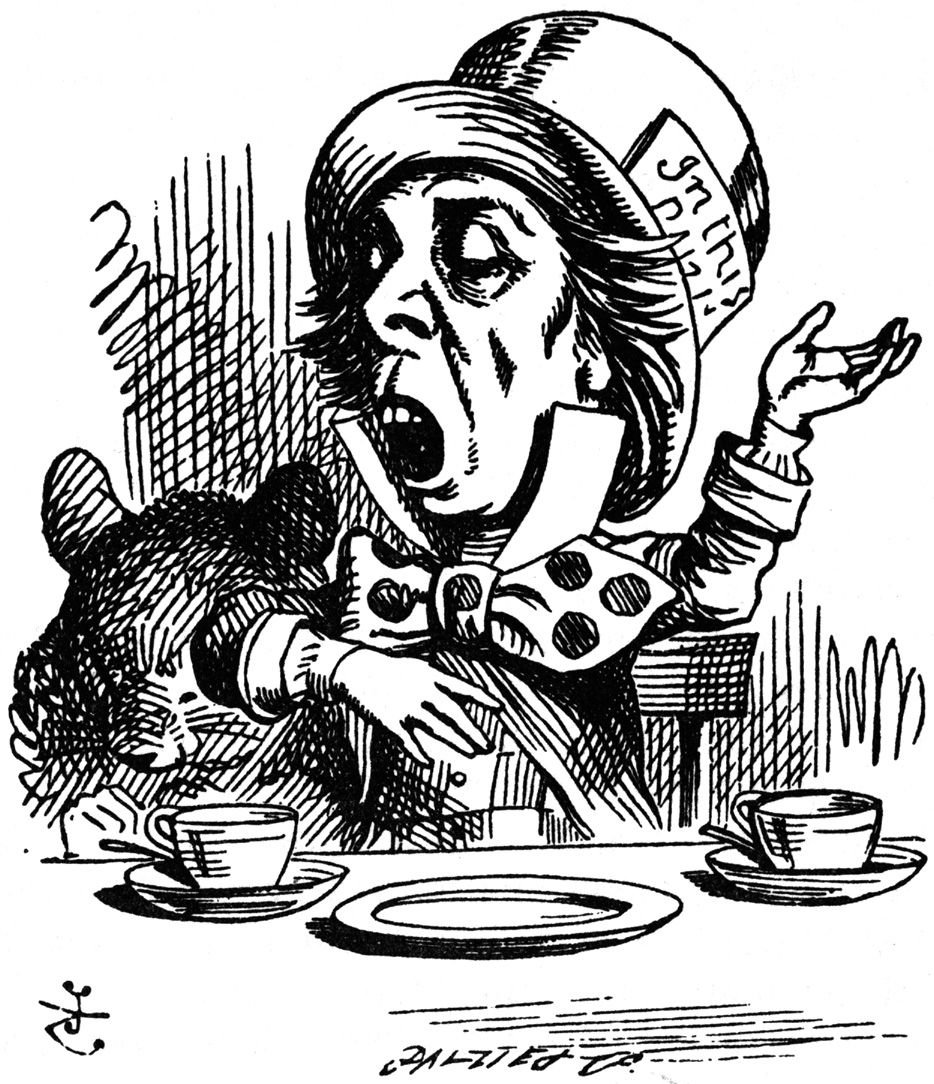 |
"If you knew Time as well as I do," said the Hatter, "you wouldn't talk about wasting it. It's him."
"I don't know what you mean," said Alice.
"Of course you don't!" the Hatter said, tossing his head contemptuously. "I dare say you never even spoke to Time!"
"Perhaps not," Alice cautiously replied: "but I know I have to beat time when I learn music."
"Ah! that accounts for it," said the Hatter. "He won't stand beating. Now, if you only kept on good terms with him, he'd do almost anything you liked with the clock. For instance, suppose it were nine o'clock in the morning, just time to begin lessons: you'd only have to whisper a hint to Time, and round goes the clock in a twinkling! Half-past one, time for dinner!"
- Lewis Carroll, "Alice in Wonderland"
At the time of the Dingle controversy, the Royal Society had definite rules for the publication of papers submitted to it for the purpose (it may still do); rules designed ostensibly to protect both scientific integrity and progress while ensuring relevance and quality. First, a paper had to be communicated to the Society by a Fellow, only after which it could pass to mandatory assessment by referees. These referees in turn were subject to a strict rule about the basis for rejection, which Dingle cites as follows:
"a paper should not be recommended for rejection merely because the referee disagrees with the opinions or conclusions it contains, unless fallacious reasoning or experimental error is unmistakably evident."
In short, as Dingle succinctly puts it, a paper is innocent until proven guilty.
|
Dingle on Science and Dogma
|
Rather inconveniently for the Royal Society, Dingle did manage to have his paper communicated to its appointed "referees", a fact which made the rejection of it almost impossible without revealing the exact extent to which the Society had departed from its original principles and standards, if indeed it ever really had any. Of the two unnamed referees that rejected the paper, one gave as his reason that "the Society would make itself ridiculous" by publishing it, while the other, who managed at least the barest hint of a pretence of scientific judgement, cited as his reason a "fallacy so elementary" as to preclude even the effort of identifying it. He was quite serious.
When Dingle attempted to have the matter brought to the attention of the public by requesting the leading scientific journal, Nature, to publish a letter challenging the Royal Society to identify publicly the precise nature of the aforementioned "fallacy", or admit that the theory of special relativity is false, the editor refused to do so, though the controversy had been the subject of much correspondence and discussion in the journal up to that point, including articles by Dingle himself.
On another occasion the editor of Nature refused to publish Dingle's response to an eminent mathematician whose lame attempt to refute Dingle's criticism (he was one of the few who even attempted it) had been previously published in the popular journal, leaving many readers with the impression that the mathematician had got the better of the argument and had the final word. In fact, nothing could have been further from the truth.(30) Subsequent assurances by the editor to both Dingle and at least one other prominent member of the British scientific community that Dingle's response would be published were repeatedly and shamelessly not honoured, with no adequate explanation forthcoming, forcing Dingle to look elsewhere for the publication of both it and an assurance to readers keenly following the controversy that the delay in its publication was no fault of his own. The conclusion that Nature had deliberately sought to suppress Dingle's response is inescapable.

The full story of the treatment of Professor Dingle and his fatal criticism of the theory of special relativity is told best by the man himself in Part One of his book which deals specifically with the moral question. Links to an extensive selection of quotes from both Part One and Part Two (which deals with the intellectual question) can be found here and here respectively. We note that while these might also serve as an abridged version of the book, they are, of course, by no means intended as an adequate substitute for serious researchers. You can download the full version of Science at the Crossroads here or here.
Relativity is Useless
Two of the most common misconceptions that the public have about relativity theory are its relation to GPS technology and the atom bomb. Indeed so transparently flawed are these notions that one can only marvel at the efficacy of the propaganda and misinformation that generates and fosters them. Moreover, this kind of misconception in the public mind is not accidental or exclusive to special relativity theory by any means. In the article "Darwin on Trial: Secular Materialism Under the Microscope" and its companion article, we expose a similar strategy of misassociation applied to evolution theory; a similarity suggestive of a common source.
Let's dispel.
 |
| Above: Einstein's contribution to the development of the atom bomb was entirely political, not scientific. |
Firstly, atom bomb technology is based on the phenomenon of nuclear fission as discovered by German chemists, Otto Hahn and Fritz Strassmann in 1938. (Nuclear fusion would later also play its part.) Essentially, the harnessing of nuclear fission, and in particular the chain reaction required for an atomic explosion, was made possible by combining the fissile properties of isotopes of uranium and plutonium with variously contrived real world conditions; conditions that had to be determined and engineered. One of the key technical problems for developers, for instance, was finding a way to extract the fissionable U235 isotope of uranium from the much more abundant, but non-fissionable, U238.
What is important to understand is that nuclear weapon technology was developed like all technologies by patient and not so patient trial and error in the non-relativistic, real world. (A certain amount of intrigue was also involved.(31)) Moreover, the popular notion that atom bombs are an horrific illustration of the "mass-energy equivalence" relationship expressed by Einstein as E = mc2 is a misguided one. The enormous amount of energy released by the chain reaction of a nuclear explosion is attributed by physicists almost entirely to the release of energy that binds the nuclei of atoms together, both when a heavy nucleus is split into smaller parts and when light nuclei fuse together to form heavier ones. This immense release of energy has nothing whatsoever to do with the mass-energy relationship expressed by E = mc2 or anything else remotely associated with Einsteinian theory.(32)
As for relativity theory's relationship to GPS functionality, there are in fact two quite distinct questions to be addressed with respect to the latter; though they are often conflated by relativists. (cf. the conflation of micro and macro evolution by Darwinists). The first question concerns whether corrections for altitude and/or motion based "time dilation" effects are applied to GPS satellite clocks in such a way as to improve GPS accuracy. And the second concerns whether it necessarily follows from a yes to the first question that GPS is a bona-fide practical application of either the special or general theory of relativity or both.
The second question is the simplest to answer: no it does not. General relativity mathematics doesn't tell us anything about the effect of altitude on the physics of an atomic clock beyond postulation(33), and the problem with the special relativity model for motion based time dilation effects is that it is paradoxical, as we have seen. Readers are invited to read carefully the document, "GPS and Relativity: An Engineering Overview", by scientists for the GPS Joint Program Office of the Aerospace Corporation in the US. The paper is instructive for the purposes of the present article not so much because of its opening lines confirming the non-application of relativistic corrections to the GPS Operation Control System (ground control), but because of the explicit reference it makes to the "paradox" Herbert Dingle makes the subject of his book, Science at the Crossroads.
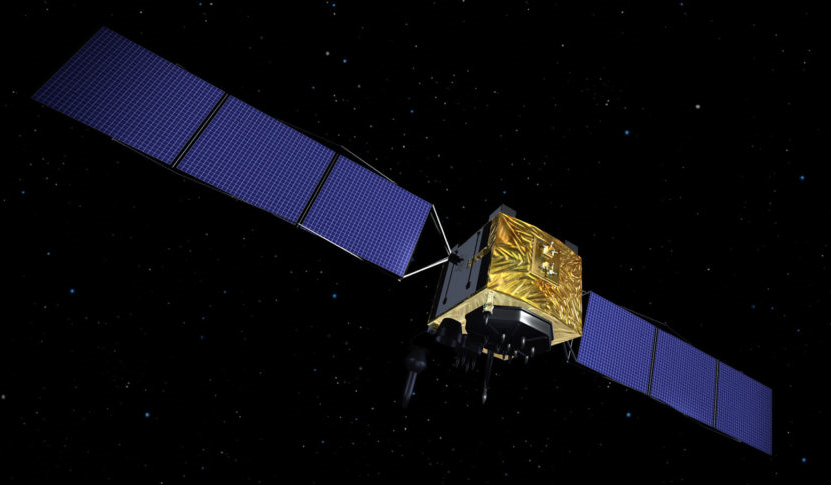 |
| Above: an artist's impression of a GPS satellite in space. |
Particularly instructive is the GPS paper's summary dismissal of said "paradox"; a treatment so typical of technicians and so-called "teachers" alike, when it comes to special relativity, as to serve as a paradigm. Readers of the paper are simply advised to "accept intuitively the fact that there is no real paradox here". In case that fails to satisfy readers, they are further advised that "the relativistic formulas defy our intuitions of time and space, but not the basic principles of logic; they can stand." No other explanation or elaboration is given beyond reiteration. We are simply assured of the fact and that's that. Apparently the scientists attended the same school of science-by-decree as Einstein.
Anyway it's no problem if you don't mind turning a blind eye or two - the paper's subsequent "relativity" calculations simply assume a standard frame of rest aptly titled the "Earth Centered Inertial"(ECI) which serves to give the calculated data some practical meaning. After all, Einsteinian nonsense is all very well, but when there's real work to be done ....
Now, let's investigate the claim that time dilation corrections are made to GPS satellite clocks. Readers are referred to the well composed and easy to follow online article "GPS, Relativity, and pop-Science Mythology", part one and two. To summarise (with some additional comments by the present author):
1) According to the US Department of Defence a "relativistic correction" corresponding to a 38 nanoseconds a day slow-down is applied to synchronised GPS satellite clocks prior to launch. (7ns faster to account for the supposed special relativity motion effect and 45ns slower to account for the supposed general relativity altitude effect.) Unfortunately we only have the word of the US DoD to take for it.
2) The cause of any real world discrepancy between satellite clocks and ground clocks is a theoretical question with possible explanations that include non-Einsteinian (logically consistent) ones. The value of the discrepancy, on the other hand, is a practical matter. At some point GPS engineers need only have compared the rate of an unadjusted atomic clock in GPS satellite orbit to the standard ground clock rate.
3) Assuming an adjustment has been made (whatever the cause of the discrepancy may really be) such an identically applied correction to satellite clocks would make no difference to the calculated distances between satellites and ground receivers that GPS uses for "trilateration" (positioning). This is because GPS receivers like the one in your car do not use the ultra expensive and cumbersome atomic clocks that satellites reportedly do. Therefore, said calculations are necessarily done by the receiver using satellite clock data only, making any discrepancy between satellite and receiver clock rates irrelevant. This is important to understand as even high profile relativists have been known to mislead on this elementary point. The distance from a receiver to a satellite is calculated as follows:
d = |tr - ts|*c (where ts is the time a signal leaves the satellite, tr is the time same signal reaches the receiver and c is the speed of the signal, which is the speed of light).
For the purposes of trilateration this calculation is made on the basis of data from four different satellites so that the receiver can solve not only for its three spatial variables, x, y, z, but also for its own time reading (or "timestamp"), tr. This latter variable can then be discarded as superfluous to the position co-ordinates. Another way of putting it is that GPS trilateration depends only on the difference between timestamps from the satellites and this difference remains the same as long as the satellite clocks are all synchronised and the adjustments made to them are identically applied, as is reportedly the case. Local time is not required.
4) While slowing down satellite clocks by 38ns a day would not result in any difference to trilateration calculations for receiver position as per (3), it would make a difference to ground based calculations for satellite orbital position. The resulting daily difference to the latter, however, would only amount to about 15cm at most, up to an accumulative maximum of 52cm before a weekly "reset" kicked in. This kind of difference (which would largely cancel out in many cases due to the changing directions of satellites and the averaging of readings) is well within GPS error limits of 2 to 3 metres. What that means is that there is no way of telling, by using GPS, if a 38ns slow down to satellite clocks has even been applied at all.
5) When relativists make their calculations for "time dilation" they make certain approximations/simplifications so as to avoid the issue of real world complexity. In practice, changes in altitude caused by varying terrain locations of receivers, and changes to satellite speeds (relative to receivers) caused by varying latitude locations of both satellites and receivers, would introduce a level of complexity that could not be practically applied to GPS as presently devised. The fact that no such complexity is adjusted for shows that "time dilation" corrections are currently insignificant to GPS functionality.
6) Alleged "secondary relativistic effects" can or ought to be explained non-relativistically and there are indications of obfuscation and evasion regarding this.
7) The author concludes that "science gurus" should know better than to deliberately foster the impression that GPS functionality serves as a test for relativity theory.
(Click the Note number to return to its position in the article. Note that all page numbers listed for "Science at the Crossroads" below refer to the online pdf version which can be downloaded here.)
(1) Regular readers of this website may notice the essential similarity to other issues also, such as the holocaust fraud and the geoengineering atrocity.
(2) Herbert Dingle, "Science at the Crossroads", Chapter 1, p.19
(3) ibid. Chapter 4, p.45
(4) ibid. Chapter 3, p.30
(5) Dingle needn't have worried, at least in regard to special relativity. Scientists and engineers working in the real world know better than to pay anything more than lip service to special relativity theory when it comes to practical application. (See also "Relativity is Useless" above.) On the other hand, Dingle's more general concerns have proved perspicacious.
(6) In fact, Dingle specifically mentions the complicity of the Press as one of the reasons for writing his book:
".... that again is part of the reason why I have been forced to use the medium of a book to acquaint the public with the position in which it stands: a body of scientists, in whose uncontrolled hands the physical safety of the whole community lies, is daily engaged in experiments of the greatest potential danger, based on principles which the experimenters confess they do not understand, and the Press is closed to any criticism, however well informed, of their activities, and to all questioning of their decisions." ibid. p.8
(7) Writes Dingle:
"....[Einstein's] weakness, as we shall see, lay in his relative inability to follow up the implications of his insight and in a too great readiness to accept a promising starting-point as an achieved goal. He was rather like one of a body of men imprisoned in a dungeon, who alone perceives an opening offering a means of escape, but omits to verify that it does not lead merely to another part of the dungeon." ibid. p.104
and elsewhere,
"I still think that Einstein's perception of a possible escape from the dilemma of the time a mark of the highest genius, though his failure to see that it could not be actual when it needed such slight additional thought to make that unmistakably evident, reveals all too clearly the limitations of that genius." ibid. p127
There are of course other, less kind interpretations of Einstein's all too convenient and inexplicable blind spots. For example, American astronomer, Professor Charles Lane Poor, famously described Einstein as a "confusionist". Indeed it is difficult not to conclude that Dingle is being over-generous or diplomatic. After all, how can it be the "mark of the highest genius" to take something seriously that only "slight additional thought" reveals as nonsense? In fact all Einstein did with his special theory of relativity was to find an explanation for some troubling optical experiments of the period that seemed both plausible to some and unfalsifiable to all. The method is a familiar one to all clever tellers of tall tales. (cf. the article "Darwin on Trial: Secular Materialism Under the Microscope".)
(8)
In the preface to his book, Dingle writes:
.... the theory of relativity is believed to be so abstruse that only a very select body of specialists can be expected to understand it. In fact this is quite false; the theory itself is very simple, but it has been quite unnecessarily enveloped in a cloak of metaphysical obscurity which has really nothing whatever to do with it; the physical theory itself, indeed, is much simpler than many physical theories familiar to most educated non-scientific but interested persons in the nineteenth century; it is wholly devoid of any mystical significance.
and later in Chapter 8, he asks:
".... what will be the state of mind of a public taught to measure the value of an idea in terms of its incomprehensibility and to scorn the old science because it could be understood? The times are not so auspicious that we can rest comfortably in a mental atmosphere in which the ideas fittest to survive are not those, which stand in the most rational relation to experience, but those which can don the most impressive garb of pseudo-profundity." ibid. p.6, 128
(9) ibid. Chapter 3, p.33
(10) ibid. Chapter 7, p.104
(11) Writes Dingle:
".... mathematics has been transformed from the servant of experience into its master, and instead of enabling the full implications and potentialities of the facts of experience to be realised and amplified, it has been held necessarily to symbolise truths which are in fact sheer impossibilities (but are presented to the layman as discoveries) which, though they appear to him absurd, are nevertheless true because mathematical inventions, which he cannot understand require them. The situation is precisely equivalent to that in which the zoologist assured the astonished spectator of the giraffe that if he understood anatomy he would know that such a creature was impossible - except that, in physical science, the layman usually believes what he is told and, unless he is enlightened in time, will be the victim of the consequences. This phenomenon, most evident in relation to special relativity, is now common in physical science, especially in cosmology, but its culminating point lay, I think, in the acceptance of special relativity, and it is with that alone that the present discussion is concerned." ibid. p.5
(12) Note that pages and chapter numbers listed in the present article all refer to the pdf version of Science at the Crossroads available here.
(13) A Word on Logos
Reason and logic are "Logos", the basis of the God spell. Saint John tell us in his Gospel that Logos is Christ. Substituting the original Greek term "Logos" for the standard English Gospel translation, "Word", we get:
"In the beginning was Logos, and Logos was with God, and Logos was God. The same was in the beginning with God. All things were made by him; and without him was not any thing made that was made. In him was life; and the life was the light of men. And the light shineth in darkness; and the darkness comprehended it not." John 1, 1-5
Logos can be understood here as purely objective, common principle; the goal of real science. A fact is a fact. Logic is logic. It is not exclusively your logic or my logic or your fact or my fact - it is absolute. Thus Logos is ultimately both wordless and formless, for though it is manifested in word and form, the underlying principle exists and can be understood even in the absence of expression and causation, or thought. Conversely, Logos can go essentially unrealized by those who articulate it.
Logos is eternal - it is not ephemeral matter, be it physical or psychological matter; emotion, impression, belief, non-belief. These latter are transient even if they happen to be superficially consistent with Reality. After all, a suitably "qualified", persuasive or deceptive speaker, editor, writer, theoritician or statitician may come along and change one's mind. Or, more gradually, the passage of time and experience may diminish or nullify a previous rhetorical effect (hence the requirement of constant repetition to maintain it). Alternatively and more dramatically, the mind in question may have a head on collision with Reality. Logos, on the other hand, is beyond flux. That which is seen with Logos mind cannot be unseen, for it is based on a truly rational and intelligent (dispassionate, disinterested and holistic) appraisal of what actually is. The effect is at once profound and transformative.
Dingle demonstrates his own appreciation of the ascendancy of Logos in authentic mental order in chapter 5 of Science at the Crossroads when in response to a shallow Ethos-based criticism of his argument he explains how distasteful it is to him to feel compelled to reply in kind by citing his own world-assigned (and incidentally ample) qualifications.
"I could continue in this vein," he writes on page 73, "but it is distasteful and, moreover, I consider that the question should be decided on its intrinsic merits and not by a comparison of personal records."
Obviously it is only a lazy or inferior (disordered) mind that resorts to shallow impressions and the say so of others rather than Reason in accepting or rejecting an argument. At the very least a Logos oriented mind will simply admit that it does not really know or understand (presently).
Logos incarnate, Jesus Christ, had no world-assigned status or qualifications and as such did not depend on them at all for the authority which which He invariably and profoundly impressed His followers and listeners.
(14) Einstein's claim that he did not know about the world famous Michelson-Morley experiment of 1887 at the time of writing his 1905 special relativity paper, despite confessedly being aware of other more obscure optical experiments is, to say the least, an unlikely story. It is, on the other hand, suggestive that he should wish to conceal the fact. Actually, in addition to unspecified optical experiments, Einstein cited as further impetus for his theory "asymmetries" arising from the application of the electromagnetic field equations of Scottish physicist, James Clerk Maxwell (1831-1879), which were not, according to Einstein, "inherent in the phenomena". It is questionable, however, to what extent the quest for mathematical symmetry was a primary motivating factor for the formulation, promotion or acceptance of the theory of special relativity.
(15) Syllogistic Sleight of Hand
Readers should note that the significance of both the Michelson-Gale and Sagnac experiments, as well as others of similar import, like the one conducted by British astronomer, George Airy, in 1871, is invariably misrepresented or partially expounded by orthodox texts and science propaganda, including Wikipedia articles. Those serious about understanding these experiments are advised to make a clear distinction between the data itself and mere interpretations of same, including the published interpretations of the experimenters themselves in some cases. The data may not be, in fact, exclusively consistent with one explanation, despite being presented as such explicitly or implicitly. Such misrepresentations can be very subtle and easy to overlook.
The same caution applies to specialist and non-specialist mainstream media "science" reporting in general.
Consider, as typical, a February 2010 propaganda piece in the UK online newspaper, The Independent , titled, "Einstein's theory is proved - and it is bad news if you own a penthouse". (Screenshot here.) There are in fact a number of misrepresentations in the full article, but it will suffice for our purpose to examine specifically the claim of the headline itself. First, notice that it states unequivocally and boldly that Einstein's theory is "proved". In particular, it refers to a new super accurate optical clock and its rate at different altitudes. (Note that though the ultra-precision of the clock is much emphasised in the article for effect, it is in fact irrelevant to the question of proof, as we shall see.) The claim in the article is that tiny variations in the clock's rate at even very small differences of altitude on Earth prove Einstein's general theory of relativity. Do they really? Let's investigate. What does the scientist interviewed for the article actually say ?:
"We would say our results agree with Einstein's theory – we weren't expecting any discrepancies and we didn't find any...."
In fact, the scientist (whose words are very carefully chosen and misleadingly interwoven with article dogma) is not speaking about a proof at all, but about some unspecified data that he deems to be not inconsistent with general relativity postulates. The critical fact that same data is not inconsistent with other possible explanations as well is conveniently left out of the article discussion. Indeed, the "science editor" of The Independent would appear to be counting on the fact that the majority of his newspaper's readers do not have the background knowledge or the logical discipline to notice the syllogistic sleight of hand in the headline, or, alas, the inclination or capacity to remember anything but the headline. Please understand, there is little or no chance that a science editor of any worth could allow such a misrepresentation to get by him by mistake. In fact, the article is but one example of many in a clearly discernible and highly coordinated pattern of deliberate misrepresentation of both Einstein and relativity theory in non-specialist and specialist media sources.
For an alternative discussion of the experiments of Michelson and Gale, Sagnac and Airy by author and Youtuber, Malcolm Bowden, click here and here and here respectively. Note that the Airy experiment is commonly and misleadingly referred to as "Airy's failure" by the mainstream scientific community, when they dare to refer to it at all. Of course, prejudice is implicit in the epithet - it effectively and summarily assigns one questionable interpretation to the experiment to the exclusion of others ....
|
The Centre of Everything
|
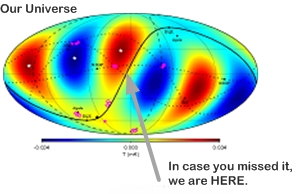 Compare the Airy experiment epithet (see above) to the one assigned to the astounding discovery in more recent times that essential features of the Cosmic Microwave Background map of the Universe are aligned with our Earth-Sun orbital plane (known as the "ecliptic") and equinoxes. The alignment has been dubbed "the axis of evil" by the devotees of scientism with all the impartiality and objectivity we have come to expect from them. Nonetheless, after the conclusion of the latest mission by the "Planck spacefcraft" in 2013 (there have been two earlier missions) a spokesman for the European Space Agency conceded:
|
(16) Dingle on Experimental Tests of Special Relativity
|
For an easy to follow article on the spurious "meson" (or "muon') confirmation of "time dilation" click here.
Time for Fraud
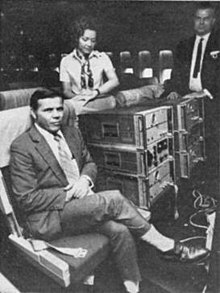 |
| Above: Hafele and Keating on board and ready to roll. Their 1972 report declaring a "qualitative" success for relativity theory was an unconscionable fraud. |
Probably the most notorious case of relativity fraud is the Hafele-Keating experiment in which four caesium atomic clocks were taken on long aeroplane journeys in both eastbound and westbound directions. The idea was that the difference in flight direction on a rotating Earth would affect the clocks in different ways according to relativity theory. Now, quite aside from any question as to whether there is circular reasoning inherent in such a test, and quite aside from the fact that the experiment could serve, at best, only as a test for motion based "time dilation", and not the innately paradoxical special relativity theory, what the Hafele-Keating experiment is most notable for is its outright resort to fudging of figures. The paper exposing the fraud (by A.G.Kelly) can be read here or here. It concludes:
"The H & K tests prove nothing. The accuracy of the clocks would need to be two orders of magnitude better to give confidence in the results. The actual test results, which were not published, were changed by H & K to give the impression that they confirm the theory. Only one clock (447) had a fairly steady performance over the whole test period; taking its results gives no difference for the Eastward and the Westward tests."
Nonetheless the experiment is instructive, if not to physicists, then certainly to truth seekers, or even anthropologists, who may find it both interesting and revealing that an experiment that has been so thoroughly and irrefutably debunked continues even today to be cited not only in science propaganda, but also in university and other physics texts, as a "qualitative" success for relativity theory. Why?
(17) What's in a Name?
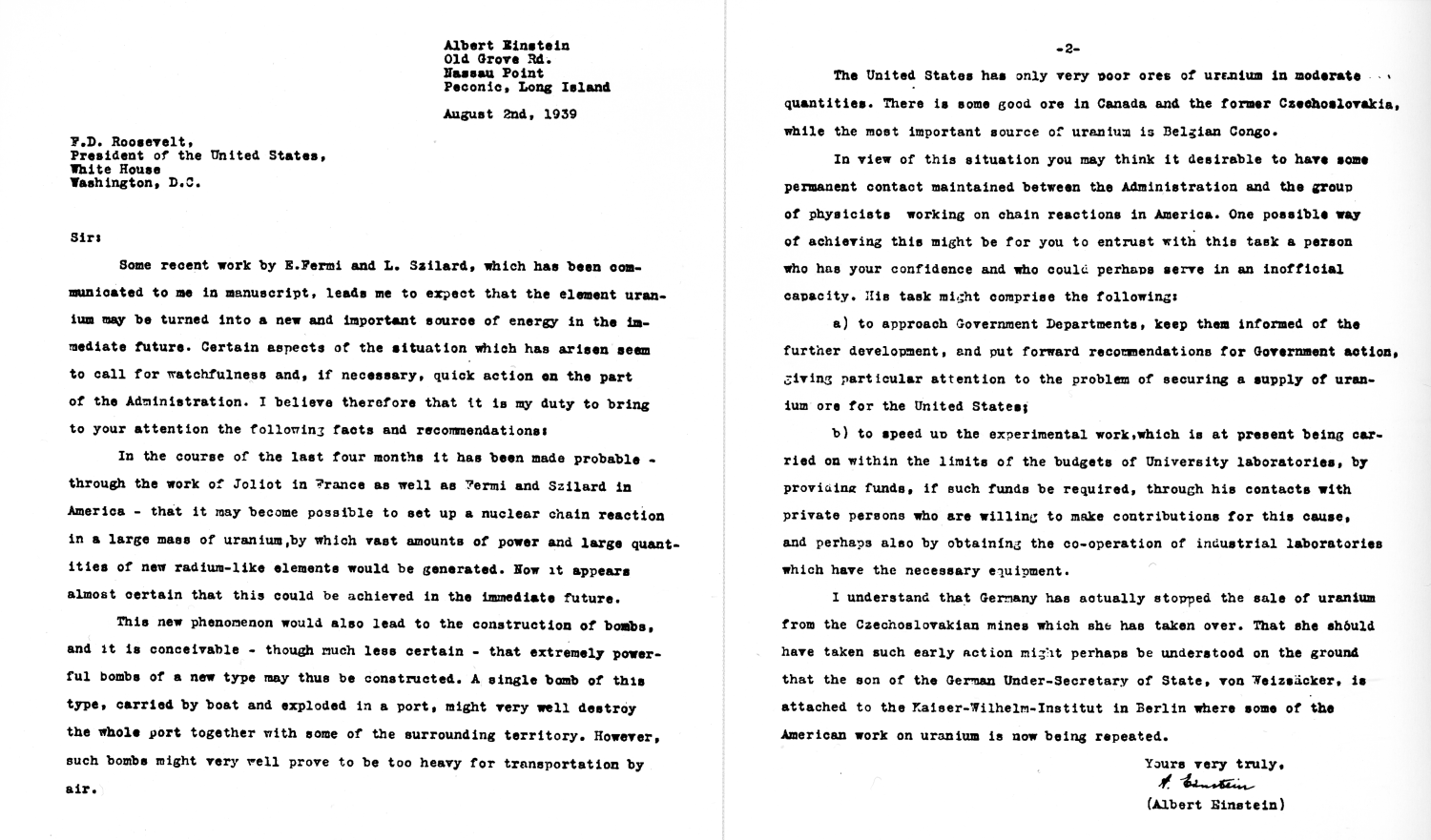 |
| Above: the Einstein-Roosevelt letter that Einstein didn't write. Click the image to enlarge and read. |
Politicians and bureaucrats are not any less prone to impressionable naivety and shallowness than others.
When Jewish scientists, influence and money sought to provoke Roosevelt into initiating an atomic bomb project just prior to the second world war, Einstein was asked to put his name to a letter to the President so that it might be taken more seriously. The letter was written by Jewish physicist, Leo Szilárd, and presented to the President by another Jew, Alexander Sachs. No doubt the allusion in the letter to "private persons who are willing to make contributions for this cause" referred to sources of similar ethnic character. Still another Jew (and Judaeo-atheist), Robert Oppenheimer, would later play a key administrative role in the "Manhattan project"; a project that would result ultimately in the construction of the immensely destructive A-bomb.
In standard Jewish propaganda doublespeak, of course, the Szilárd letter has taken its place in the cult of Einstein as a story about the latter's pacifism - we are told he regretted his contribution to the atom bomb project (which was entirely political, not scientific) after seeing the horrific destruction wreaked on Nagasaki and Hiroshima. (Perhaps he considered the technology better suited to the destruction of Europe.) Meanwhile, in stark contrast to the Jewish effort, the National Socialists in Germany, under the slogan "make use of warfare for physics not physics for warfare", declined to develop nuclear bomb technology (though Germany was by far the best placed country to do so), concentrating their efforts instead on developing nuclear fission as an energy source. In any case, it goes without saying that President Roosevelt had no personal understanding at all of the theories or work of Einstein and was simply impressed by the name; that is to say, the superficial media stories, imagery and second hand information/"advice" with which that name was invested.
Another story is perhaps even more telling about the intellectual shallowness of politicians and bureaucrats, despite its relative obscurity.
After the entry of the US into the second world war, Einstein was asked to declare faulty a certain detonator mechanism that the US Naval Ordinance Department had designed, in the hope that some long overdue corrective measures would be taken by the department. In fact, the fault was of the most elementary mechanical character and was pointed out to Einstein on behalf of exasperated mechanics. Nevertheless it took Einstein's non-expert co-operation to secure a result.
Clearly there is an extraordinary amount of power to be wielded by men who are taken to be paragons of "genius" or virtue by the simple-minded masses and political classes; and by those who control the imagery and impressions invested in their names, even after the original bearers are long dead. In fact, such is the entire basis of all false religion, and always has been.
(18) ibid. Chapter 8, p.126
Elsewhere Dingle writes:
".... the fact is simply that the sine qua non of true scientific research - the ever-present consciousness that the demands of no theory, however successful, must be allowed to qualify those of fact and reason - has silently faded away. The automatic reaction to criticism is not to face it but to look elsewhere for some independent justification for ignoring it. The depth to which we have descended is exposed .... by one ardent believer in the relativity theory .... who asserts that criticisms of [special relativity] theory are symptoms of mental abnormality* and that to treat them seriously is a waste of time. That this - though not usually so candidly acknowledged - truly describes the general attitude I have overwhelming evidence, and until it is brought clearly to light and ruthlessly transformed our peril is inestimable." ibid. p.31
*see also the articles "Psychiatry: Science or Fraud?" and "A Word or Two on Mental Fitness".
(19) ibid. Chapter5, p.67
(20) ibid. Chapter 1, p.19
(21) ibid. Chapter 8, p.119
(22) ibid. Chapter 8, p.118. Elsewhere Dingle writes:
".... in much modern cosmology, those who speak of 'space-time' naively imagine that it refers literally to something existing objectively, and so deceive themselves and others into thinking that the world which is the world of all of us has an esoteric quality that only the specially gifted can understand." p.121
|
For the mathematically inclined .... 
Though the mathematics of Minkowski do give the ideological contortionism of special relativity "space-time" something of a presentable form, American astronomer, Professor Charles Lane Poor (1866-1951, pictured right), pointed out a long time ago that when the invariant "space-time interval", s2 = x2 + y2 + z2 - (ct)2 or (ct)2 - (x2 + y2 + z2) is converted to the standard Pythagorean invariant form of real-world Euclidean geometry, a complex (imaginary) number i is revealed in the time(t) or space(x,y,z) co-ordinates: x2 + y2 + z2 + i 2(ct)2 or (ct)2 + i 2(x2 + y2 + z2)
showing that "spacetime" geometry, while certainly a mathematical curiosity, has no correlation in physical reality, and thus no place in physics. Note that by convention the spacetime interval is always expressed as a square (s2) - the unsquared variable (s) is never exposed as such - thus making it easier for relativists to forget the fact that they are dealing with physically meaningless roots of negative numbers. The convention is reminiscent of the decision by scientists in 1983 to redefine length in terms of the distance travelled by light, thus making it much simpler to ignore any empirical evidence that the speed of light is not a constant in so-called empty space. |
(23) Perhaps two of the most hyped "confirmations" of Einsteinian relativity theory actually pertain not to the special but to the general theory. One of them, however, namely the Eddington eclipse experiment of 1919, resulted in such media hype that it effectively launched the special theory of relativity out of the obscurity in which it had been languishing since 1905 in the shadow of Lorentz, to prominence almost overnight; a prominence and dominance completely at odds with its intrinsic vale (which is zero), even today. The other so-called confirmation concerned the precession of the perihelion of Mercury.
Both can be shown to be spurious. Firstly, on grounds that Eddington's measurements of the bending of star-light around the Sun were not statistically significant or honestly reported, and secondly, on grounds that both were mathematically ill-conceived. And while the first objection is often countered by citing later, similar experiments in which errors and "confirmation bias" are allegedly diminished or removed, there is no countering the mathematical argument, which is fundamental and applies to both cases.
The case is presented with customary clarity by US astronomer and professor of celestial mechanics, Charles Lane Poor, in a paper from 1923 entitled, "Relativity: An Approximation". We note in addition to Professor Poor's essential criticism that there are perfectly plausible, non-relativistic explanations for both the perihelion and star-light observations in question.
What is important to understand for the purposes of the present article is that there is simply no way that either Einstein or Eddington could have been ignorant of the fundamental inadequacy of these experiments as confirmations of relativity theory, unless we are prepared to believe that they were fools. If they weren't fools, they were scoundrels - it can only be one or the other, or both. (In fact, the two, properly understood, always go together.) Given then the hype that these "confirmations" received, and continue to receive, both in scientific and non-scientific media (a hype with which both Einstein and Eddington fully co-operated when they were able) the conclusion that we are dealing here with a concerted political, cultural and, indeed, spiritual movement as opposed to authentic scientific enterprise, is unavoidable.
(24) Relativity and Morality
Regarding his fatal criticism of special relativity theory, Dingle writes:
"Here is a challenge to a theory that not only, as [the science journal, Nature] says, 'in spirit as well as in detail has come to pervade the whole of modern physics', but also has the deepest implications for general philosophic thought and public safety." ibid. p.43
He might also have said morality. Clearly there is much more at stake here than our understanding of physics. Questions of cosmological significance and morality are always related, it is folly or worse to deny it. The acceptance of fundamentally relativistic principles in the former serves to lend credence to a similar approach to the latter, so that, for instance, concepts like "truth" and "justice" are taken to be "observer dependent" with "no absolute frame of reference". We have previously explored on this website the pernicious practice of disguising subjectivity as objectivity in the so-called "social sciences". The effect is a similar one. Both entail a movement away from transferable, objective perception to one non-transferable and subjective, or solely relative; a movement that is inherently divisive and isolating, not to mention unscientific. Only objective perception based in the Absolute (which is the Father) can provide the common ground on which we ever really meet and co-operate; and on which we can love one another (in Christ) beyond mere sensation or emotion or desire. See also "Psychiatry: Science or Fraud?"
|
(25) Dingle's Test
The experiment described in the story of the "The Great Ballistic Road Race and the Magic Bullet" is precisely the one proposed by Herbert Dingle in Science at the Crossroads as an authentic (kinematic) test of the second postulate of relativity, only of course, adapted to light. Moreover, the essential nature of the "experimental difficulties" to which Dingle alludes regarding it, are undoubtedly analogous to the reasons "Albert" gives in the story for why the "magic bullet" cannot be tested. Dingle describes his experiment as follows: |
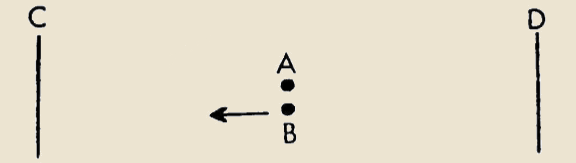
(26) In order to keep the ratio of distance over time constant for light (i.e. d/t, which is speed), a "contraction" in the numerator must be offset by a "slowing down" in the denominator.
(27) Creative Accounting
 |
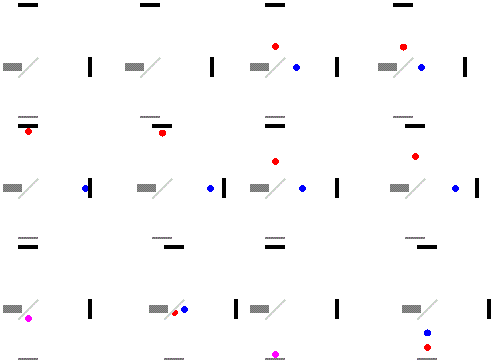 |
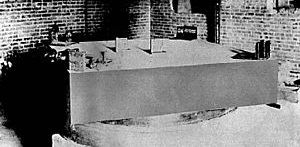
| Top: The actual apparatus or "interferometer" of the 1887 Michelson-Morley experiment in the basement of Adelbert Dormitory of Western Reserve University in Cleveland, USA. The stone slab on top is floating on a bed of mercury to allow it to be rotated slowly. Bottom: An animation showing the essential idea of the experiment. On the right is what Michelson and Morley expected to see for maximum relative displacement of two light beams (represented by the blue and red dots) travelling on equidistant perpendicular paths on an Earth presumed to be moving through the ether around the Sun (taking the interferometer along with it). On the left is what they actually observed, assuming the "null result" generally attributed to the experiment. The most obvious inference that the interferometer (as a whole) was not moving, was simply ignored. Enter the Franken-physics of Einstein. |
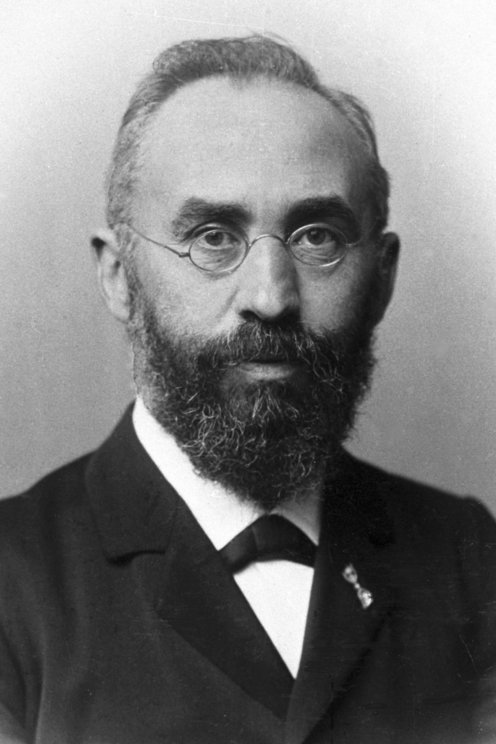
The Lorentz transformation is to physics something like what "creative accounting" is to book-keeping. It was first formulated by Dutch physicist H.A Lorentz (1853-1928) to explain away the troubling results of the 1887 Michelson-Morley experiment.
In short, the Michelson-Morley experiment was designed to detect the "ether wind" using the presumed speed of the Earth as it revolved around the Sun (30km/sec). The ether was the stuff scientists believed to pervade the whole universe and provide the medium through which electromagnetic waves, like light for example, travelled. It was reasoned that just as sound waves travel faster when a wind blows the air they are travelling in along, so too must light waves travel faster (or slower) when travelling with (or against) the ether wind created by the Earth moving through space.
It was conjectured that the maximum relative displacement of two light wave-fronts that split and meet up again after travelling perpendicular to each other on equidistant paths on a rotating platform, would correspond to the presumed speed of the Earth going around the Sun (creating an equal ether wind speed in the opposite direction). Remarkably, however, the expected result of the experiment was not forthcoming. A maximum displacement corresponding to 5 to 8 km/sec was measured instead of the expected 30 km/sec, despite the "null" result (i.e. zero displacement) that is generally attributed to the experiment. The Michelson-Morley result was later more or less confirmed by other optical experiments, notably those of Miller.
There were (in hindsight anyway) three possible explanations available to scientists at the time: (1) the Earth is not revolving around the Sun, (2) the Earth is revolving around the Sun at 30km/sec through the ether, but there is some heretofore unthought of reason why experiments are unable to detect it as such, and (3) there is no ether.
The first possibility was dismissed summarily as ideologically unacceptable fantasy by the high priests of atheism and scientism incumbent, while the adoption of the second or third was deemed acceptable pending the formulation of the most plausible explanation that fantasy could proffer to support them.
 |
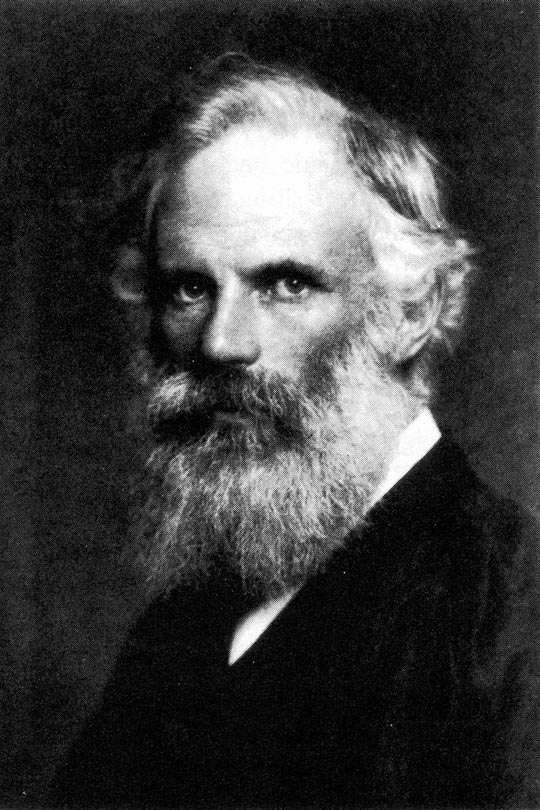 |
| Lorentz(left) and Fitzgerald | |
Enter Lorentz, who together and independently of an Irish physicist by the name of G.F Fitzgerald (1851-1901), suggested that the reason light waves travelling with or against the ether wind (in the Michelson-Morley set up) got to the receiver at the same time as those travelling an equal distance across it, was that the whole experimental apparatus mysteriously shrunk in the line of its movement by just the right amount to compensate for the ether wind effect. Amazing! Lorentz then calculated the factor by which it would have to do so in order to match the observations (presuming of course the "null" result that never happened) and thus was conceived the "Lorentz-Fitzgerald contraction".
Later, Lorentz would formulate a more comprehensive theory (usually referred to by physicists as the "Lorentz ether theory" or just simply, "Lorentz theory") that extended the hypothesised transformation of the space (length) co-ordinate to include a combined transformation of both space and time. It is this more comprehensive mathematical fix that is known today as the "Lorentz transformation".
For those who insist on the maths, here it is (for simplified one-dimensional space):
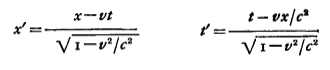
where (x',t') and (x,t) are the space and time co-ordinates for two inertial reference frames with relative velocity, v, and c is the speed of light.
It is important to note that while Lorentz theory is mathematically indistinguishable from special relativity theory (which it preceded) the basis is different. Specifically, the former is not, strictly speaking, a relativity theory at all, as it does not reject the ether as a standard of rest by which velocities, distances and times can be given an absolute meaning. As such, it manages to avoid the logical inconsistencies inherent in an Einsteinian universe where light waves no longer have a medium to travel in and time and length not only "dilate" and "contract" in as many different ways as one cares to imagine, but also in two completely contradictory ways at the same time ....
(28) In other words, only "space" and "time" as Einstein arbitrarily defined them are subject to magical, relativistic transformations. The concepts of absolute space and time are right where we left them, along with reality, morality and common sense ....
(29) Regarding the use of the term "paradox", Dingle urges caution:
"It has been a common and very effective device in [the field of criticism of relativity theory] to avoid the necessity of admitting a contradiction by calling it a 'paradox': it is thereupon automatically regarded by those who do not consider themselves experts in the subject as something to which there is of course an answer, like the paradox of Achilles and the tortoise, which it is not their concern to provide and to which therefore they need pay no further attention." ibid. p.128
Moreover, it is important not to conflate the paradox that Dingle makes the chief subject of Science at the Crossroads with the much cited "twin paradox" with which Dingle was also famously associated and to which he devotes chapter 9 of his book. Though the twin paradox is related to Dingle's criticism, and was indeed a part of Dingle's journey to it, the former differs ultimately from the latter in that it includes in its essential scenario non-uniform motion, that is to say, acceleration. The problem with this is that it has traditionally given relativists a specious escape route in that special relativity is a theory of uniform relative motion only. In fact, Einstein resorted ultimately to imagining arbitrary, homogeneous gravitational fields in his effort to explain away the paradox of the twins. Yet Dingle shows conclusively, in Chapter 9 of Science at the Crossroads, that the twin paradox or, more properly, the question of "asymmetric ageing", has never been resolved either.
(30) The "final word" of the mathematician in question, namely, Professor J.L.Synge of the Dublin institute of Advanced Studies, was typical of responses to Dingle's criticism in general - inadequate and shallow. Essentially Synge declared his intention to "cast my vote" in favour of special relativity because "it appears to me to represent nature more closely than Newtonian physics"; a statement that Dingle correctly identifies as an evasion of his question rather than an answer to it. Of course, the fact that a prominent and respected mathematician could reduce an important scientific question to the level of ballot box appearances is at once both disturbing and revealing.
(31) During the second world war the Germans declined to develop nuclear weapon technology, opting instead to pursue the potential of nuclear fission as an energy source, thus belying the gist of the scaremongering tactics employed by international Jewish elements to provoke an atomic bomb project in the US (see note 15 above). Later, as the war drew to a close, key German research facilities were looted by the Allies, including an experimental nuclear reactor in Haigerloch, and German scientists were rounded up and taken into British and American custody, where they were put under constant surveillance, surreptitiously. The Soviets "acquired" German scientists in a similar way. Significantly, the Soviet nuclear project lagged years behind the US effort after the war.
The timing of the Allied raids and appropriation of key personnel in Germany, as well as the fact that the Soviets had by comparison much less access to German research facilities and scientists, is suggestive. Indeed, despite allied propaganda downplaying the possibility, it is more than likely that German technology and know-how provided the US with key and decisive elements of the atom bomb technology they would use against Japan only a few months after the close of the war in Europe, just as German V2 technology provided both the US and the Soviets with the technological basis of what would later become the "space race". As for the Soviet nuclear project, it was undoubtedly aided and abetted by Judaeo-Bolshevist spies within the US and its administration - Gold, Greenglass and the Rosenbergs to name the more notorious few, but also Morris and Lona Cohen - and probably at much higher levels than has ever been officially disclosed or confirmed. It is worth noting that the Cohen's "American scientist" source has never been revealed, while Oppenheimer had his "Q clearance" conspicuously removed in 1954.
(32) Click here. [Update December 2019: the link we provide here is to the the archived Max Planck Institute web page article. Curiously, the original page was relocated, re-designed and given a new misleading subtitle (to reinforce a similarly misleading title) probably some time in June, that is, soon after we published our link to the original page .... If all else fails, and to check against changes, you can find a screen shot of the original here. CG]
(33) Do we need general relativity mathematics to explain the effect of changes in gravity potential (and thus the energy of the system) on the period of a particle clock?